Manufacturing v16 260125
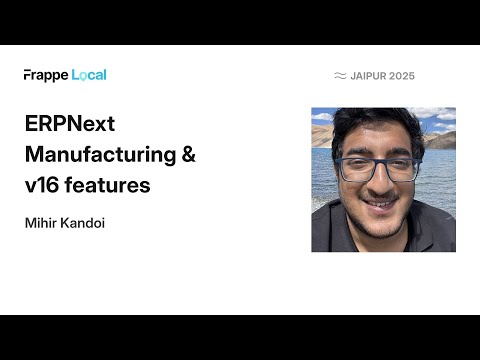
The transcript features a presentation by a developer for ERPNext, focusing on the evolution of the product and the specific functional leaps coming in Version 16 (v16).
Below is a detailed summary of the features and capabilities discussed:
1. Core Concept and Philosophy
The speaker defines an ERP (Enterprise Resource Planning) as a tool to consolidate fragmented and disconnected business processes into a single system.
- Automation: By using a single source of truth, a single entry (like a Purchase Invoice) automatically updates multiple ledgers (Suppliers and Stock), reducing manual effort and errors.
- Framework: ERPNext is built on the Frappe framework, which allows for high customizability—a critical requirement for diverse business implementations.
2. New Manufacturing & Stock Features (v16)
As a developer specialized in Stock and Manufacturing, the speaker highlighted several major technical additions:
Material Requirements Planning (MRP)
This is a significant upgrade from the previous "Production Plan" module.
- Sales Forecasting: Users can now forecast demand using the Holt-Winters method, which accounts for both market trends and seasonality.
- Master Production Schedule (MPS): A new document type that integrates sales forecasts, current sales orders, delivery schedules, and item reorder levels.
- Automated Planning: The system generates a final report identifying exactly when to manufacture finished goods, sub-assemblies, and raw materials to fulfill orders on time.
Serial Number & Batch Traceability
- End-to-End Tracking: Provides a full genealogy of a product. You can track a specific serial number from the purchase receipt of raw materials through the manufacturing stock entries to the final delivery note.
Stock Reservation
- Inventory Locking: To prevent "stock-outs" where items are promised to one customer but sold to another, v16 expands reservation capabilities.
- Expanded Scope: Stock can now be reserved within the Production Plan, Subcontracting Order, and Work Order. Once reserved, the system blocks that stock from being used elsewhere.
3. Subcontracting Inward
While ERPNext previously handled outward subcontracting (sending materials to a third party), v16 introduces Inward Subcontracting (acting as the manufacturer for a customer).
- Subcontracted Sales Order: Allows businesses to specify services sold and the finished goods to be returned to the customer.
- Zero-Value Accounting: Since the customer owns the raw materials, the system tracks them for compliance (e.g., e-way bills) but records a zero-balance impact on the manufacturer's books.
- Hybrid Procurement: If the manufacturer provides a few raw materials themselves (e.g., a resistor for a circuit board), the system automatically adds those specific items to the final Sales Invoice.
4. UI/UX and Frappe Framework Updates
The speaker noted that the underlying Frappe framework has been redesigned for a better user experience:
- Redesigned Dashboard & Workspaces: A cleaner look with a new sidebar, updated charts, and app-specific branding/logos.
- Revamped List View: "Noise" like rarely used tags and "assigned to" fields have been moved to prioritize data. The "Awesome Bar" (search) has been relocated to the top left.
- Enhanced Grids (Child Tables):
- Scrollable Columns: Users can now add unlimited columns to a row without having to open a separate pop-up window.
- Sticky Columns: Users can "pin" specific columns (like Item Name or Rate) so they remain visible while scrolling horizontally through other data points.
5. Future Roadmap
The development team follows a "pick your own work" philosophy and prioritizes features based on community and customer demand.
- Potential Additions: Evaluation is underway for WMS (Warehouse Management Systems) and MES (Manufacturing Execution Systems).
- Goal: To make ERPNext a true end-to-end solution for every business requirement.
Would you like me to dive deeper into any of the specific manufacturing methods mentioned, like the Holt-Winters forecasting?